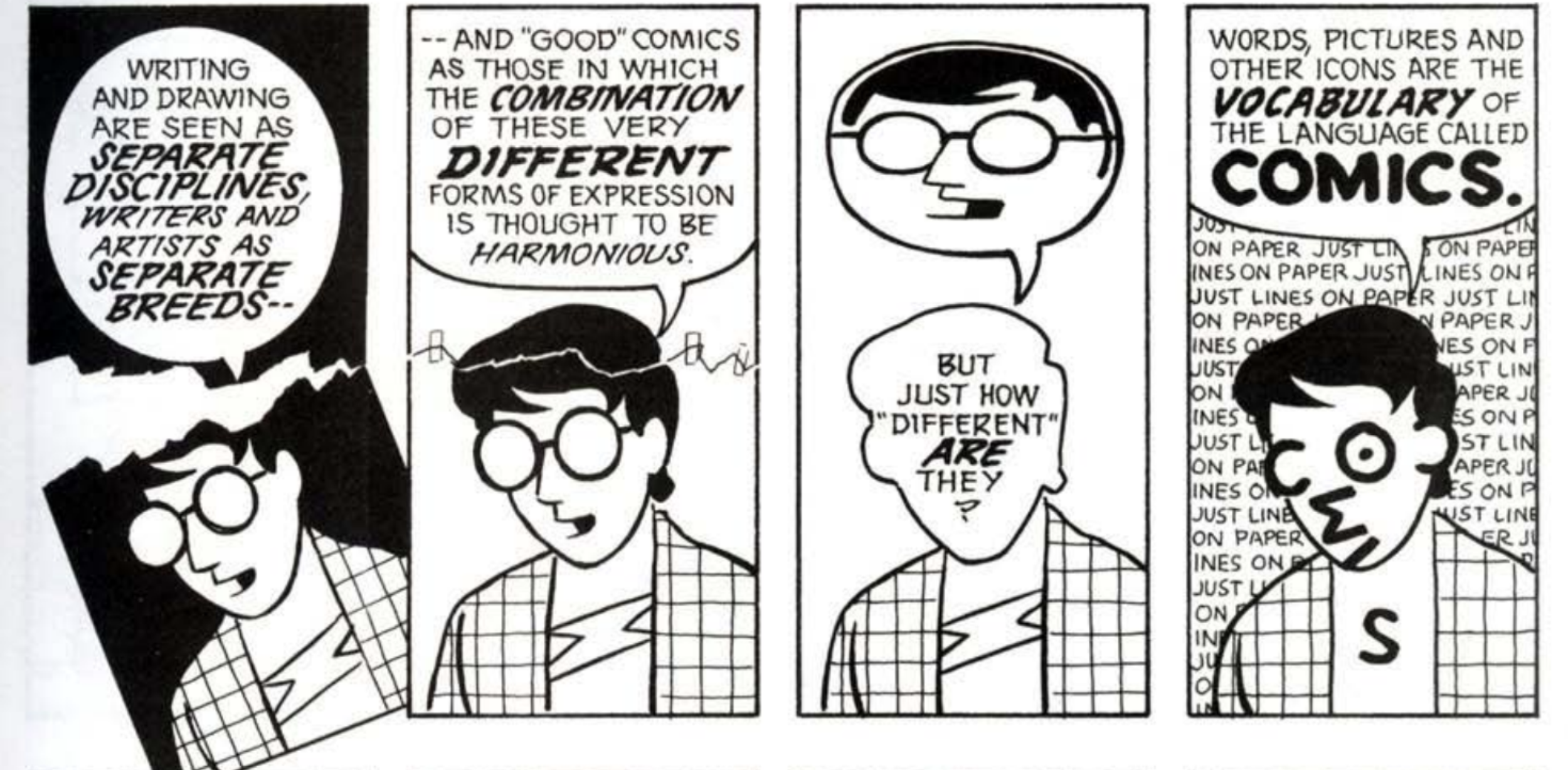
The Secret Language of Comics

Tracing Pages Reflection

When I first began this tracing project, I was admittedly skeptical about its difference from traditional comparative analysis. The process of physically tracing and annotating two pages from the books seemed far removed from the traditional analytical writing I was used to. However, now that I’ve completed it, my initial hesitation has transformed into an appreciation for this hands-on approach.

The act of tracing and annotating was surprisingly enlightening. By tracing, I was able to immerse myself in the visual narrative in a way that mere observation couldn’t allow. Each curve and line I traced drew my attention to subtle details I’d previously overlooked. Annotating alongside allowed me to capture my observations in real-time. For example, in “Stitches,” I realized how the disproportionate size of a tear on a character’s face could encapsulate a world of grief. Also, after filtering the words and dialogue, I can pay more attention to the subtle change in the gesture and facial expression of the characters.

Adapting to an inductive essay structure with an “And-But-Therefore” (ABT) thesis was challenging initially. I am accustomed to starting essays with a clear thesis, but this method pushed me to build my arguments progressively, making the final thesis more thoughtful. It was a restructuring of my usual analytical process : instead of presenting my point and then defending it, I laid down the observations, added nuances, and then synthesized them into a coherent argument. I finally made the thesis: ” Both “Stitches” and “Spinning” harness the emotive power of tears and manipulate time, but they apply these elements differently to accentuate the emotional resonance of their narratives, therefore highlighting the inherent versatility of the comic medium. “

This assignment undoubtedly deepened my understanding of the intricate language of comics. Tracing and annotating forced me to slow down and appreciate the craftsmanship behind each panel. This close reading exercise shed light on how even minor details can significantly impact the narrative. Post this project, I feel I understand “Stitches” and “Spinning” at a much deeper level.

link to analysis: sarahshao04.wordpress.com/drawing-emotions-a-comparative-analysis-of-stitches-and-spinning/

link to assignment prompt

Office Funny

The process of creating this assignment was very much like that of the Triptych. Although the middle section spanned two panels, it allowed more room for the creative process. I did not have to jam in my thoughts into one panel. I was thinking about getting a job in the future and how I would have fun behind a cubicle. The answer in my brain was that I would not have fun behind a cubicle. So, this strange, lame prank by “Bob,” that does not end up pranking “Sarah,” shows that I do not think I would enjoy myself in a cubicle. It does not show that I would like to place fake snakes around the office. Not my style.

Tracing Pages Reflection

The thesis of my essay was about how the authors used different techniques to express changes in the characters’ eyes and the transformation of time. David Small and Tillie Walden both used these elements when they were describing a major moment in their life when they realized a truth. Though the techniques may be different, the purpose and effect of these techniques are similar.

The tracing process was a unique experience to me. The last time I had a project similar to this was an art class in middle school, so being able to do this again was refreshing. While I was tracing, I left out the dialogues because I thought it would have been difficult and would take too much time. However, without the dialogues, I found out it made me focus on the images themselves, which helped me observe more minor details that I later used in my analysis. For example, the subtle changes in the eyes of David on the page I chosen was a detail I did not notice before. The annotations I made supported me when I was forming my argument. I tried to write down everything I thought about the scenes in my annotations. Whenever I ran out of ideas or explanations for my argument, I would take a look at my annotations and find more evidence.

For this assignment, I tried using the inductive reasoning technique. Unlike my previous essays, I did not write my thesis first; instead, I kept it as the last thing I wrote. Even though the process felt unnatural, I realized it gave me more freedom. In the past, I felt constricted when writing my body paragraphs since I had to connect it to the thesis. However, in this essay, I did not have a thesis to follow through. Thus, I wrote down every idea I had in mind, and only worried about the thesis in the end, which was able to include all of my arguments.

With this assignment, I think it helped me a lot on understanding this secret language of comics. Instead of skimming through, I feel that I am able to read the hidden messages placed within or between panels. At the same time, the stories seemed much more in depth and complete after understanding how to analyze comics. The single biggest insight I gained about the two books during the whole process is that childhood experiences do not fully shape who we are.

Link to Analysis

Link to Prompt

Tracing Stitches and SPinning Reflection

Link to Analysis

Link to Assignment

The autobiographical nature of Spinning and Stitches requires an emphasis on the physical body of David Small and Tillie Walden, but they differ in how they emphasize, either through maximalizing or minimalizing their art. With context, the emotional tension is built through a question: What will happen next? The process of writing this essay was really interesting for me. I focused a lot on the mediums that the graphic novelists seemed to use, whether it was ink or watercolor, since I was using pencil. Trying to replicate David Small’s linework was a lot more difficult because there is very precise but jagged linework. I think I focused a lot more on what took time, which allowed me to discover the idea of maximalizing and minimalizing in the panels.

The ABT structure was really confusing for me. I ended up just writing an introduction then cutting it out at the end.

This assignment was really fun for me as someone who has never really gotten into comics before. I thought I gained a lot of insight into the artistry of it and how the different styles of art allow the graphic novelists to best express their emotions. The single biggest insight I gained was the interwovenness of the art and writing in comics and how it truly couldn’t be separated. Even the lack of words in a panel says something.

Spinning + Stitches Reflection

I feel that this assignment was an all encompassing task that allowed us to examine comics in the way that we have tried to in our class discussions. The process of tracing the pages made me more aware of the choices author’s made when drawing their comics and encouraged me to deep dive into what these choices did for their expression. I noticed more of the little details like how shading and reflections were used to emphasize mood in the Stitches page. My writing process was made more free with the concept of putting the thesis in the concluding part of the essay. It was more “free” in the sense that I felt that my argument structured my thesis instead of the other way around. This allowed me to go down different paths in arriving at the expression of my argument that Tillie and Small both make intentional choices in the “secret language of comics” in order to show their  journeys in dealing with different traumatic experiences. I feel that by close-reading and asking myself why each author made specific choices, I am able to better understand the secret language of comics and how it is used to make a comic that successfully tells a story. Working on this assignment has enlightened me in the sense that I can now see that even the smallest details like, the different facial expressions shown on characters faces, can change how a certain panel of a page is viewed. This has encouraged  me to read closer and dissect comics or illustrations that accompany texts with greater intention.   

Spinning & Stitches Analysis

The first pattern that I would like to point out is the author’s choice of frame in order to depict a certain atmosphere of sadness that is characterized by its prevalence in each of the pages that I traced. In Spinning, Tillie Walden uses the absence of words in order to draw readers’ focus to the drawing being shown in the bottom left portion of the panel. The absence of words is what makes the reader focus in on what Tillie has drawn and from this focus, there is great emphasis on this melancholic atmosphere that is the result of the traumatic sexual assault experience in earlier pages. In the sketches shown, there is a range of emotions on characters being illustrated, including sadness, a blank expression, happiness, and discomfort. I feel that the range of emotions depicted is what makes the drawings that have sad faces stand out as they are the most prominent figures. The range of emotion also points to how emotionally isolated she felt in her sadness as those around her couldn’t see what she had felt and experienced. Choice of frame along with Tillie Walden’s choice of image with the broad range of emotions being shown is what creates this sorrowful atmosphere. In Stitches however, Small uses choice of frame in a different way, utilizing repetition as a means of emphasizing and expressing this down mood. The overwhelming atmosphere of sadness is created through the recurring images of rain that dominate the span of the page. Unlike what Walden does with adding empty space to the frame, which she used to emphasize a sad atmosphere, Small uses the lack of empty space in order to bombard the reader with rain and create this sorrowful tone that cannot be ignored. So much so, that the reader can then understand the depression Small felt was inescapable. This undismissable atmosphere is also created through Small’s choice of frame, showing rain patter down the window from a view inside the house, conveying this idea that the sadness is unavoidable. The fact of the matter is that even though there is cover, the rain is still present, meaning that sadness doesn’t simply disappear when you try to remove yourself from the source. 

Another pattern I would like to point out is that both of these pages followed shortly after a traumatic event or a connection to trauma had been established. In Spinning, this gloomy page falls shortly after Tillie is sexually assaulted by her tutor and in Stitches, the page showing the different rain scenes follows shortly after David comes to deal with the fact that he hasn’t felt his mother’s love all throughout his childhood. This brings me to the idea of graphic narratives being labeled as feminist by Hillary Chute who states, “I claim graphic narratives, as they exhibit these interests, ‘feminist.’ All of the authors I discuss here investigate concerns typically relegated to the silence and invisibility of the private, particularly centered on issues of sexuality, and all address childhood trauma.” Chute labels these graphic narratives as feminist as they address issues often kept hidden. This statement connects to the idea that through comics, both Walden and Small are utilizing this form of literary expression and intentional choice of frame, image, and moment in order to convey the dominance of sadness in their emotional composition in their pursuit of dealing with traumatic experiences. 

Small and Walden are attempting to show how trauma changed their lives but they had different experiences to convey, therefore the differing choices they made in expression were likely the result of such. Small felt he had to show how prevalent and long-lasting his depression was, being the consequence of ignoring his trauma for years, failing to deal with his mother’s absence of love, so he used repetition as his main tool of expression. On the other hand, Walden felt she wanted to show the emptiness in life that resulted from her trauma so she utilized the choice of frame as a tool to show empty space on the page, conveying the void created by her experience. All in all, both authors are very intentional with the choices they made to show how depression had a significant presence in their dealing with their trauma and how their experiences affected them in different ways. 

Different Choice of Frame to show different means of expressing how trauma made author feel

Stitches

Spinning

MLA Citation: Chute, Hillary L. “Introduction.” Graphic Women: Life Narrative and Contemporary Comics, Columbia University Press, New York, 2010, p. 6. 

Sleep Advice

This sketch represents a hilarious reality that I have found myself in before. Though I am not ignorant enough to wonder why I am always tired while up at 3 AM, I have been up late on YouTube before and found myself watching a video about sleep or something similar. The expert in the video will mention the importance of quality sleep and how beneficial going to bed early is, and I often have an existential moment of irony where I realize I should not be watching this video at 3 AM. The funniest part is there are always people in the comment section of these videos who are also watching at ridiculous times. I believe this represents a deeper reality in which it is enjoyable for us as humans to see someone describing the life we want to be living, but do not truly care enough to make it happen.

SK7- Halloween anyone?

This is my quadriptych sketch. The idea came randomly when I was sketching random drawing trying to come up with an idea. Since Halloween was near, I decided to do a funny comic where the reader is put in a tense situation at first. As you read on, you realize it’s just a trick or treater at the door.

css.php