The Secret Language of Comics

Halfa Kucha Reflection

The actual style of the oral presentation has stark differences from creating an argument in essay form. But when I was creating the slides, I felt that I was crafting an argument in a very similar manner. My thought process during slide creation was to simply compare and contrast the characters while drawing correlations to the main idea of trauma in men and women. Looking back at my process, I feel that I could have written an essay without much deviation from my thought process. But the real difference came with the actual action of talking in front of the class. It is easy to take time to get every word out that you can think of when typing an essay in a quiet room, but talking in front of others creates a different environment. I felt that the nerves and time restrictions that come with a presentation like this caused me to stick more to the main points of my argument while mentioning a few sub-points. Contrarily, an essay would allow the argument to be fine-tuned and developed to a deeper level. But, the skill of being able to present an argument orally is very worthwhile making this exercise extremely important. 

One decision that I made for my presentation that I am very happy with was to use images outside the comics. I believe it allowed me to speak more generally about the plot and not have to worry about sticking to the actions of any one page at a time. This pushed me to orally defend my argument with the pictures to support me rather than trying to explain individual pages. Also, I feel that the pictures were more eye-catching than a slide can be because of the lack of text while also allowing some humor to slip through. The lack of text also allowed me to quickly be reminded of my talking point with a glance rather than trying to distinguish which words were being said. 

Public speaking has always been one of my biggest fears. Even when I feel that I have conquered that fear, my heart will begin to beat out of my chest once I get into the environment of my presentation. The same happened for this assignment. When I saw my name on the speaking order for the day, I instantly felt the adrenaline rush through my body. But unlike most times I have spoken, I took a couple of deep breaths and consciously felt my heartbeat slow and my skin cool. I was encouraged by the comfort that I felt while talking and hope that this experience will only give me more confidence in the future. The time limit for every slide was especially beneficial in keeping me from rambling and on task. Sometimes, I have the tendency to go off on tangents but the focused nature of this prompt could not have been more helpful for that purpose. 

Halfa Kutcha Reflection

Link to The Winding Path to Healing:

The process of making this presentation looked like first brainstorming different connections I could make between texts and for some reason I felt that Stitches and Kindred could relate in some way. This hunch ended up being the basis of my argument when I read over the prompt and found the excerpts from  Trauma and Recovery: The Aftermath of Violence — From Domestic Abuse to Political Terror where Judith Herman makes several claims regarding the trauma and recovery process.  I found that two quotes from the excerpt closely align with the ways this healing process went in the two novels that I chose so that’s when I decided to use the excerpt as my argument’s foundation.

The way I went about organizing this presentation is by creating a notes page where I wrote out everything that I wanted to capture for each slide. This allowed me to see my ideas clearly and expand in areas where deeper explanation would buttress my argument. This type of organization would be helpful when applied to written work because it can assist with getting over that first obstacle in writing where you don’t know where to start. Simply spitting out whatever ideas are floating in your brain without putting them under critique allows one to get their ideas flowing. I also feel that my addition of certain arrows and symbols allows for a more streamlined viewer experience where my audience can easily follow from one idea/point being made to another. Considering both of these organizational strategies could be used in written work, I can see myself using them in my next piece. I am also proud of the intentionality that went into choosing my visulas. I made sure that each image had some relevance to the title of each slide and that they would flow from one visual to the next in a manner that creates a cohesive argument. For example, when looking at the “Establishment of Safety” slide, I wanted to implicitly show a difference between present-day and the antebellum era so I used a not-equal-to sign accompanied by images that correlate to images on either side. 

When it came to the presentation of my slides, the whole concept of auto-advancing slides was sort of disorienting. Even though I had practiced, talking in front of an audience made me speed up involuntarily. In order to combat this I tried to slow it down a bit that proved to be disorienting as well because I was a little late in making my point on certain slides. However, when efficient and intentional practice is implemented to prepare for a Halfa or Petcha Kutcha, this form of presenting could be very effective and fluid in making an argument. Something that I could have done that I saw in other presentations was using captions on the images I used. This gave that much more clarity to what the audience should be focusing on for each slide.  All in all, this was an interesting medium to try out and I’ve learned so much about how to be a better presenter in the long run. 

Literacy Narrative Part 3 Reflection

The entire literacy narrative project has allowed me to meet the course Learning Outcomes through employing the use of technology to make a comic and then using that comic to revise the writing that I had done previously to make said graphic novel. This has allowed me to approach writing as a process that had phases with each phase offering new perspective on another, resulting in a more polished final product. It was very eye-opening to return to the literacy narrative after creating my comic. This allowed me to see how much I could revise my essay and keep a consistent message across both mediums of expression. It also helped me to realize how much I had grown as a writer in this class by allowing me to see how I used to write and rewriting the narrative based on what I had learned through the Learning Outcomes. After having worked in the visual medium, my revisions looked more like adding details that would allow a better picture to be drawn from what I had written. I feel that this would allow for a more cohesive and interesting argument to be made. This revision also involved a lot of omission which was the result of me telling the story through different means. All in all, I am glad that I got to do this multi-step assignment as it has made me more mature as a writer and taught me a lot about expression as a process along the way. 

Literacy Narrative Pt. 3 Reflection

The nature of this three part literacy narrative has presented a perfect opportunity for me to think introspectively throughout this semester. The topic of how my journey in reading has molded me growing up is something I have rarely thought about. I think this was reflected in the flaws of my first narrative because I focused way to much on now and not enough on how I got here. One of the biggest edits I made for my final narrative was to expound upon my transition from books to reality. I was inspired for years by the fictional characters in the literature I read growing up, but it took some special role models in the real world for my eyes to be opened to my true potential. In my final version, I made sure to emphasize that critical transition so that my childhood experiences with literature could be better understood as a cause for my development. My experience with trial and error in my writing this semester follows the learning outcome of writing being a process. The sketching of this narrative was also monumental in my understanding of that transition that I had from books to reality. The process of examining some of my classmates’ narratives allowed me to compare with stories with that of others. I was also able to take their advice and encouragment to improve my own narrative. For example, Tofi complimented my targeted capitalization of words of emphasis in my sketch, so I made sure to add even more of that to my final version. That process followed the learning outcomes involving being collaborative with my classmates and evaluating the ideas of others.

Literacy Narrative Pt. 2 Reflection

Turning my literacy narrative into a comic proved to be more difficult than I had expected. I struggled to combine the visual aspect with the narration in a way that told a coherent story. It felt like I was still relying on the words to convey most of the information, so I tried to put as much detail into the drawings to support the ideas in each panel. 

I was unsure if my narrative felt like it was a comic because for the majority of the panels, I used text to narrate my thoughts and actions. I wasn’t sure how else to convey my ideas, but I think I was able to compensate for this by having my drawings support and complete the ideas written as narration. 

Although there were several reasons why I felt like I struggled with this assignment, I believe that by taking the time I needed to convey my ideas, despite how hard that proved to be, is the reason why I was able to demonstrate several of the learning objectives. In specific, I think this assignment has helped me reach the goals for writing as a process and visual thinking. I spent a lot of time trying to translate my essay into the medium of comics, and after finishing my draft, I realized how essential that draft was to my final vision. It helped me come up with new ideas and patterns I could experiment with. For example, I tried to juxtapose the panels on page 2 of my literacy narrative comic with the panels on page 3. The first frame ties the pages together by showing the same image of my high school. The second frames show the difference between how I felt about many of my other classes compared to my junior year English class. I also repeated a specific visual style in the 4th frames of each page to establish the change in my mindset throughout high school. I only incorporated these visual connections after I was able to step back and think about what edits I wanted to make from my draft. 

During the process of writing my literacy narrative as a comic, I realized I felt much more comfortable expressing my thoughts and feelings with words because I could control the flow of the narrative easily and transition from one idea to another seamlessly. When it came time to create my comic, I knew I wouldn’t be able to convey every sentence I had written, but I felt unsure how to transition from one idea to another. I think in that way, if I could have had more time to expand on my comic narrative, I would have stretched out specific scenes to have several moment to moment transitions from panel to panel. Throughout the essay and the comic, my perspective was to split the narrative into 3 sections. I viewed the beginning as a way to convey my passion for reading as a child. Then, in the middle, I would transition to how school and other influences in my life caused me to lose my love of reading. Finally, I’d express how I was fortunate enough to have a teacher who really cared about making an impact on her students and how that sparked my interest in reading. Due to this beginning-middle-end structure I was attempting, I decided not to stretch out specific scenes/experiences, and instead aimed to convey the bigger picture of how my connection to reading has constantly evolved as I’ve grown. 

Literacy COmic Reflection

Creating this literacy comic started off with thinking how I could shapeshift my words into images. This part of the process encouraged me to think critically about what I should emphasize in my comic and what I should omit, in order to effectively tell the story of how my viewpoint on reading shifted. It was very different creating a comic when compared to writing out an essay because you learn quickly that expressing what you want to in a panel is much more difficult if you lack the skills in drawing. For example, if I had a better skill set in drawing I could have drawn my characters with more human-like form, being able to focus on capturing emotion and facial expressions with greater detail and emphasis. I feel that I spent more time making my drawing make sense than I wanted to, which I felt limited the depth of the story because I had to simplify so much, even the little details of what book I was reading on page 4 and why the story was so compelling to me. Thoughts regarding my literacy narrative have changed in the sense that I still have much more to discover about myself when it comes to my interactions with English in and outside the class. I feel that in creating this comic, I gained an interest in comics and how they can be utilized as an effective tool of expression in fewer words than an essay or any other conventional piece of literature.

Focusing more on the final product of this process, I wanted to talk about some of the choices I made. While reading through the comic you’ll notice that any book pictured in a panel is drawn in grayscale and without any highlighted, gold accent or color. You’ll notice however, that after I made the decision to change my approach to how I treated reading, “discovering the gold” in it, the books pictured have this yellow accent or an addition of color in some form. I made this choice in order to show how reading had been enhanced and made more enjoyable through my growing interest in reading beyond the surface and truly experiencing literature. This brings me to the decision I made on page 2 where I show how reading had become more visual to me, showing a panel with a book that translates to “When did reading become this way? I can [see] the [world] I’m reading.” I made the words “see”  and “world” into pictures to show this visualization of words. I also want readers to notice how my house shifted from “Home (Not So) Sweet Home” to “Home Sweet Home” ” after I began playing around with my newfound interest in books, reading The Family Across the Street by Nicole Trope. This book is what I wanted to capture in the final panel of my comic. The process of making this comic had many different steps like drawing out a first draft, receiving feedback, and revising your product. This aligns with our learning objective of writing as a process as we are encouraged to take our time and the necessary steps to produce something we can be proud of. All in all, creating this comic has been a layered process that has taught me a lot about myself and I can say that I’m happy with what I produced. 

Spinning + Stitches Reflection

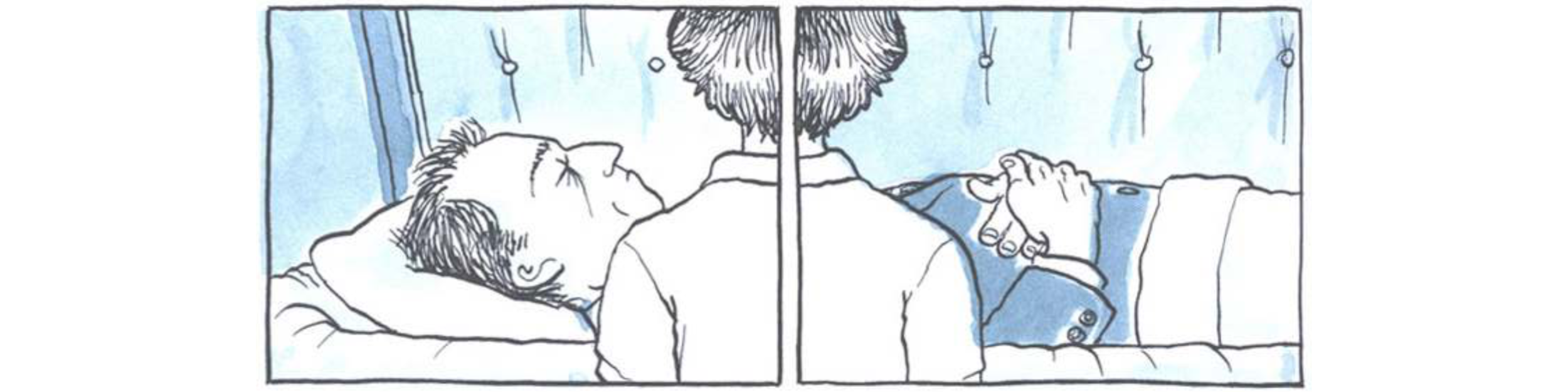
I feel that this assignment was an all encompassing task that allowed us to examine comics in the way that we have tried to in our class discussions. The process of tracing the pages made me more aware of the choices author’s made when drawing their comics and encouraged me to deep dive into what these choices did for their expression. I noticed more of the little details like how shading and reflections were used to emphasize mood in the Stitches page. My writing process was made more free with the concept of putting the thesis in the concluding part of the essay. It was more “free” in the sense that I felt that my argument structured my thesis instead of the other way around. This allowed me to go down different paths in arriving at the expression of my argument that Tillie and Small both make intentional choices in the “secret language of comics” in order to show their  journeys in dealing with different traumatic experiences. I feel that by close-reading and asking myself why each author made specific choices, I am able to better understand the secret language of comics and how it is used to make a comic that successfully tells a story. Working on this assignment has enlightened me in the sense that I can now see that even the smallest details like, the different facial expressions shown on characters faces, can change how a certain panel of a page is viewed. This has encouraged  me to read closer and dissect comics or illustrations that accompany texts with greater intention.   

Sk7 Reflection

For this quadriptych, the process started with coming up with a story that I could tell in just 4 panels. I used a similar method to one I used in my triptych of hitting the reader with a surprise of sorts at the final panel after using the earlier panels to build into it and give the fourth panel more emphasis. I got the idea of ending with “Sir, this is Wendy’s” when I remembered seeing a comment under a social media post where this user had rambled on about something that I can’t remember now, to which someone replied, “Sir this a Wendy’s drive thru”. The whole concept of being hit with such a response after pouring your heart into communicating a message is something that I find humor in. I knew what I wanted the fourth panel to look like but I didn’t know what I wanted the preceding panels to illustrate. A challenge I faced in creating this quadriptych was figuring out how I could build into that final panel. It was kind of difficult stretching similar dialogue across the first three panels because I wanted to do so in a way that the audience doesn’t get bored of what they’re reading. I did so by trying to change the scene in which dialogue was taking place. This also helped to emphasize the duration of the character expressing his feelings just to realize that he was talking to a Wendy’s employee the whole time. 

SK5 Reflection

This was the most enjoyable assignment that I have completed in this course so far. The process of creating my triptych started with me trying to conceptualize a moment that I could capture in 3 panels. Once I narrowed it down to a single idea, I thought of how I would best express that moment in drawing. In this case, I chose to over exaggerate an exchange between friends where one friend asks “Wyd rn” to which friend 2 replies, “Nun fr” implying that he’s not busy with anything. The irony of this moment hits viewers when the 3rd panel shows the full setting of panel 2 from which we see friend 2 is about to jump out of a plane. Through this series I wanted to communicate the power of perspective and also how people down play their circumstances. The most challenging part of this process was finding this moment but an honorable mention definitely goes to trying to express what I wanted to with limited drawing skill. It makes it much more difficult to express what I want when the language of drawing is sub par to my proficiency in brainstorming. This struggle to bridge the gap between the two elements of creativity is similar to my processes with the rest of the sketches we were asked to produce.

Literacy Narrative Reflection

Photo Credit: HaphazardPanda via Flickr https://flic.kr/p/29ARys9

In my literacy narrative, I dove into my pattern of being fascinated by ordinary people like me who do extraordinary things. This was fostered in my childhood through books like Percy Jackson and Harry Potter, then evolved into a lens through which I see the world. One of the most interesting parts about writing this literacy narrative was looking at my own life as if it were a novel itself. I have never before thought specifically about the ways reading has molded me in this way, and the longitudinal approach was a great way to dissect it. The connection that I was able to make at the end of my narrative between my earliest childhood memories and my recent athletic experiences was very surprising to me. I think my sentence dissecting The Matrix could be seen as the most interesting because of its applicability to everyday life, especially for those who feel like they are trapped in a corner that society has placed them in.

css.php