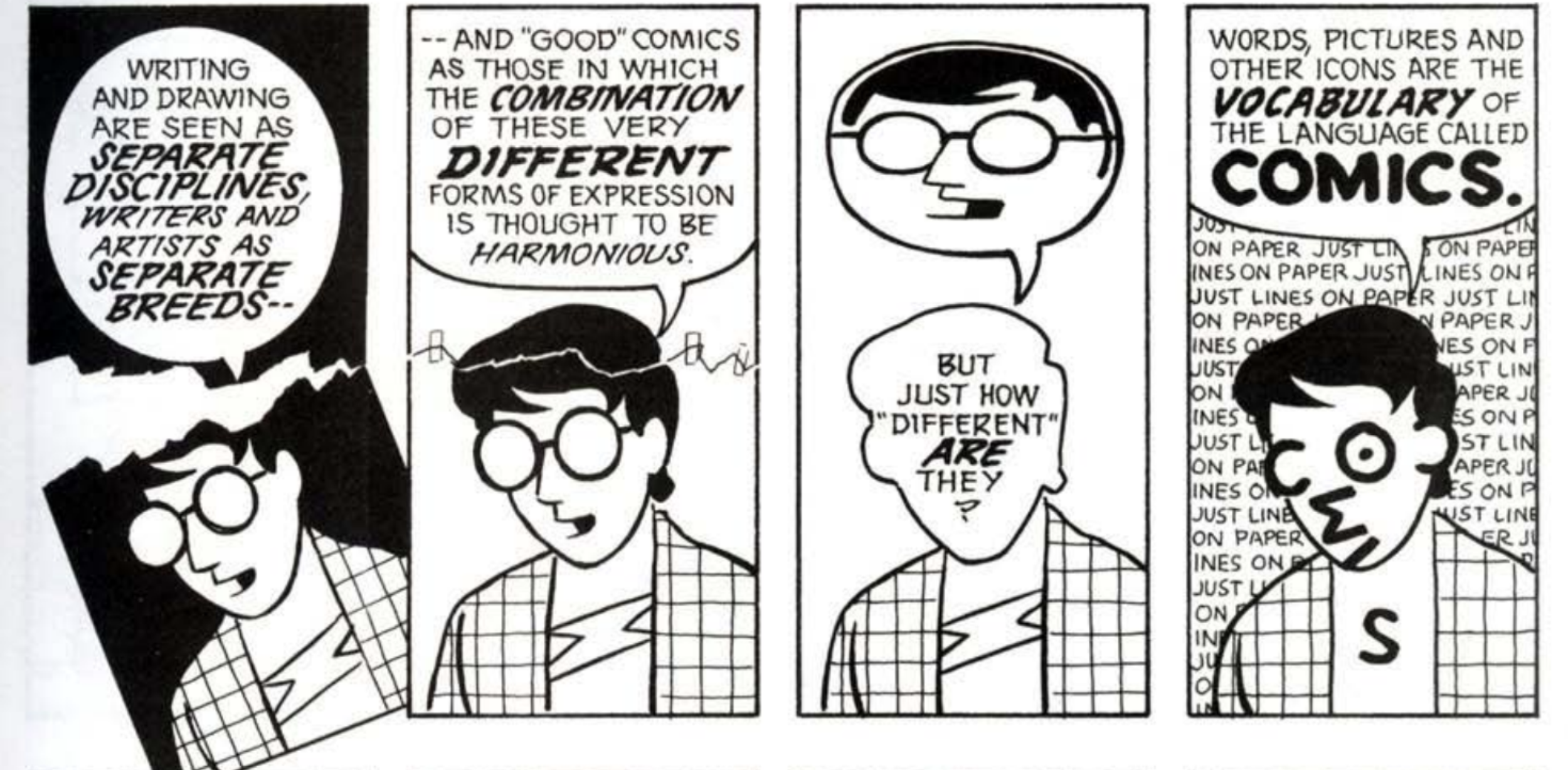
The Secret Language of Comics

Assmeblies

Photo Credits: Nana511. (2023, December 4). Gladiator. Via Flickr.

I chose to use an image from Gladiator because of how iconic of a hero Maximus is, known for his strength and honor. As a sort of Biblical reference, I hope that many of the things I have learned this semester will be added to my “armor” as I continue through the battles of college and life.

The Sword of “Hyperempathy” and The Shoes of Resilience are both tributes to the heroes that we read about this semester. Though I have no superpower like Lauren, I feel that I have gained a deeper understanding of how suffering can look this semester through so many characters in the comics. I have learned about how the stages of grief can look very different for every person like Teddy and Sandra and how important it is to be there for the people who are suffering in silence. Often, the best thing we can do is be a shoulder to lean on as we try to empathize with those suffering around us. In terms of resilience, it’s hard to think of a better personification of this word than David Small who had a beyond traumatic childhood, survived cancer, then moved out on his own while still a young teenager. Stories like his show that victory over trauma can look as simple as surviving and thriving on your own while still in the process of healing. 

The Breastplate of Validity is one that I feel that I have developed through learning to interpret comics this semester. I have always had a bit of a rampant mind that gets off track, but I have learned this semester that the place where any certain story takes me is valid and important. One of the special parts of comics is their ability to be interpreted differently by different readers who know trauma in many ways. So, it is important to be a good self-listener while reading comics and stay open to what truly comes to mind.

Lastly, The Shield of Emotional Maturity represents a large focus of mine since we began Sabrina. As a young man, I have never one who’s liked to share emotions, particularly when they could be seen as embarrassing or not masculine. I saw parts of myself in Teddy’s emotional isolation and was able to better understand how it can be destructive to not let others in. Going forward, I will be better tooled to express my emotions healthily and let others support me when appropriate. 

Halfa Kucha Reflection

The actual style of the oral presentation has stark differences from creating an argument in essay form. But when I was creating the slides, I felt that I was crafting an argument in a very similar manner. My thought process during slide creation was to simply compare and contrast the characters while drawing correlations to the main idea of trauma in men and women. Looking back at my process, I feel that I could have written an essay without much deviation from my thought process. But the real difference came with the actual action of talking in front of the class. It is easy to take time to get every word out that you can think of when typing an essay in a quiet room, but talking in front of others creates a different environment. I felt that the nerves and time restrictions that come with a presentation like this caused me to stick more to the main points of my argument while mentioning a few sub-points. Contrarily, an essay would allow the argument to be fine-tuned and developed to a deeper level. But, the skill of being able to present an argument orally is very worthwhile making this exercise extremely important. 

One decision that I made for my presentation that I am very happy with was to use images outside the comics. I believe it allowed me to speak more generally about the plot and not have to worry about sticking to the actions of any one page at a time. This pushed me to orally defend my argument with the pictures to support me rather than trying to explain individual pages. Also, I feel that the pictures were more eye-catching than a slide can be because of the lack of text while also allowing some humor to slip through. The lack of text also allowed me to quickly be reminded of my talking point with a glance rather than trying to distinguish which words were being said. 

Public speaking has always been one of my biggest fears. Even when I feel that I have conquered that fear, my heart will begin to beat out of my chest once I get into the environment of my presentation. The same happened for this assignment. When I saw my name on the speaking order for the day, I instantly felt the adrenaline rush through my body. But unlike most times I have spoken, I took a couple of deep breaths and consciously felt my heartbeat slow and my skin cool. I was encouraged by the comfort that I felt while talking and hope that this experience will only give me more confidence in the future. The time limit for every slide was especially beneficial in keeping me from rambling and on task. Sometimes, I have the tendency to go off on tangents but the focused nature of this prompt could not have been more helpful for that purpose. 

Literacy Narrative Pt. 3 Reflection

The nature of this three part literacy narrative has presented a perfect opportunity for me to think introspectively throughout this semester. The topic of how my journey in reading has molded me growing up is something I have rarely thought about. I think this was reflected in the flaws of my first narrative because I focused way to much on now and not enough on how I got here. One of the biggest edits I made for my final narrative was to expound upon my transition from books to reality. I was inspired for years by the fictional characters in the literature I read growing up, but it took some special role models in the real world for my eyes to be opened to my true potential. In my final version, I made sure to emphasize that critical transition so that my childhood experiences with literature could be better understood as a cause for my development. My experience with trial and error in my writing this semester follows the learning outcome of writing being a process. The sketching of this narrative was also monumental in my understanding of that transition that I had from books to reality. The process of examining some of my classmates’ narratives allowed me to compare with stories with that of others. I was also able to take their advice and encouragment to improve my own narrative. For example, Tofi complimented my targeted capitalization of words of emphasis in my sketch, so I made sure to add even more of that to my final version. That process followed the learning outcomes involving being collaborative with my classmates and evaluating the ideas of others.

Country 101 (For a Northerner)

Recently I became friends with someone from the north who is new to country music. When I saw the prompt for the sketch, I knew I wanted to make this playlist for them because of my passion for the genre. As a Nashville native, country music courses through my veins. I love the calming nature of the music and the simple lifestyle it endorses. I was able to make the mixtape cover using stock 3D models on PowerPoint. It is meant to represent the country lifestyle I hold dear and shares inspiration from album covers by Riley Green and Morgan Wallen. The most difficult part of this assignment for me was only picking one song from some of my favorite artists to add to the playlist. But, I was still able to pick some of the most iconic and classic country music songs that are a must-listen for those interested in the genre. This was one of my favorite sketches of the year because it allowed me to feel connected to my roots and share a passion of mine with others.

The Underdog

Rocky is truly one of the most inspiring and iconic stories in American culture. This scene encapsulates much of the fighter’s persona, proving time and time again that he could overcome adversity and reach the top of hill. I have always had a fascination with combat sports similarly to Rocky, but quickly realized that I did not want to sacrifice my brain and physical health a couple years ago after trying out boxing and wrestling. Today I still adore these films for their message of grit and actualization of the American dream. Though I am not training for a fight against the heavyweight champion of the world, I still like to take Rocky’s mindset and apply it to my workouts and life in general.

Data Visualization

Throughout my whole life, I have been most inclined to think about life from a scientific and mathematical point of view. So, I was excited to hear that I would essentially be able to run an experiment on myself for the next two weeks. I decided to split the data points that I would be collecting throughout the week pretty evenly between categorical and numerical with the intent to use them to analyze each other. My main goal was to single out some things in my life that I believe make me a better overall person (working out, reading my bible, etc.) and compare them with different evaluators of my mood (happiness, anxiety, etc.). I assumed that these things that I have always strived to do daily improve my mood and overall well-being, but I wanted to put that up to the test in this study.
My first area of visualization includes five simple graphs showing fluctuations in my numerical evaluators of mood throughout the week. It was interesting to look back at some big things that happened in my life during these two weeks and see how my mood was during that time. For example, my parents came to visit during homecoming weekend which is represented just before halfway through these graphs. It is very clear that my happiness peaked during this time and my anxiety bottomed out. The next four areas of visualization were what I was most looking forward to examining when I began this study. As expected, talking with others and taking time for self-care had a positive outcome in many different categories throughout these two weeks. A friendly conversation with someone in the class had the largest statistical impact on my mood, dropping my discouragement level by about .5 on average. Surprisingly, there was no correlation displayed between the number of people I ate with at a meal and my anxiety levels during a certain part of the day.
Looking back at the way I conducted this study, I think it is interesting that my happiness levels were on average a 6-7. I consider myself a usually happy and “glass-full” person, but one thing I realized from this study is that there are still many levels to my happiness. During the normal times this week when I was thoughtlessly going through life, I would put a 5-7 for happiness even though I was still happy. In my mind, there was nothing that was going on that deserved an 8-10 at the time. But during the few times when something bigger happened, like my parents coming to town, I decided it was deserving of a higher rating. Essentially, I feel as though I was more than a ~6.3 happy over the past two weeks, but at the same time I feel that I rated myself pretty accurately which is very interesting to me. This introspective study was one that I enjoyed analyzing and I could see myself doing something similar in the future.

Literacy Narrative pt. 2 Reflection

While I was reviewing the learning outcomes in preparation for writing this, the one focusing on writing as a process immediately jumped out at me. When I first wrote my literacy narrative part one, I was very confident that I had completed the assignment as it should be. However, after discussing it with Professor Morgen, I realized I drifted considerably toward the end and did not follow the format at all. The lightbulb went off for me once I began to think about the “and, but, therefore” thesis format. When I applied that to my childhood reading story, I realized that my essay was truly about how my history in literature became applicable to my life. So while sketching my comic, I dedicated a whole page to that process. I could not figure out for years how my adoration for other kids like me with superhuman traits would end up affecting my life, but that changed when I saw the truly awe-inspiring feats that normal people can accomplish through belief and dedication. I chose to express that through Christianity and baseball because those have both been huge parts of my life for as long as I can remember. But I do not believe there is a facet of life where there is not an example of someone who overcame their perceived limitations. This process of writing and then learning from my mistakes revealed to me what my essay was about all along.
I enjoyed writing my literacy narrative as a comic because of the opportunity to visualize my internal beliefs as a way of testing them. Coming into this class, I had very little confidence in myself as an artist. But over the past few weeks, I have realized that a belief in what I am drawing opens my mind to higher levels of creativity and interest as a whole. It felt as if I could better imagine and bring to reality the concepts I felt to be real about my life. In terms of thinking analytically, I think my mental process became more simple while I was drawing compared to writing. It could have been because I had a basis for the story already from the first literacy narrative, but this process was less stressful overall.
When I was transitioning from the rough draft that I brought to class to the final sketch, I wanted to diversify the shape of my frames. I decided the thought bubble presented a great opportunity to create a more malleable frame for the subject of my sketch. I also got great feedback in class on the targeted capitalization, so I made sure to continue that throughout the rest of the project. It seemed to me the best way to show emphasis in a way that is understandable to anyone. One piece of criticism that I got initially was that my pictures were difficult to identify, so I made sure to add identifying attributes to each. For example, I added a “Camp Half-Blood” sign in one of the Percy Jackson frames and some quotations from characters in others.

Tracing Assignment Reflection

The thesis of my essay is that the timespan that is involved with the expression of each author’s traumatic experiences leads to their variation in style. This is displayed in the way David’s sketches represent the way he felt about his mother’s abuse which is consistent with an older memory. Also, Tillie tended to give more detail about her physical interactions, which displays more robust memories and leaves the way she felt up for interpretation. While tracing and annotating each author’s sketches, I got a glimpse of the intentionality it takes to bring an idea to paper. From the largest details like a title wave to something small like eye direction, each facet of a sketch changes the way a reader will interpret it. The writing process of this essay was an adjustment for me, but I believe I was able to succeed by forcing my mind to compare the simplest attributes of each sketch without having an end goal in mind and then letting my thesis develop along with my essay. I do believe I am better able to understand the secret language of comics because of this exercise. By analyzing a specific page for an extended period like this, I was able to put myself in the author’s shoes and see how their use of an aspect of this secret language affects the way it is viewed. I subconsciously slowed down time in my world while examining Tillie’s slide that I traced, and later on, I realized this was intentional by her because the last slide of this scene is where she feels most alone and her world most likely came to a freezing halt.

Sleep Advice

This sketch represents a hilarious reality that I have found myself in before. Though I am not ignorant enough to wonder why I am always tired while up at 3 AM, I have been up late on YouTube before and found myself watching a video about sleep or something similar. The expert in the video will mention the importance of quality sleep and how beneficial going to bed early is, and I often have an existential moment of irony where I realize I should not be watching this video at 3 AM. The funniest part is there are always people in the comment section of these videos who are also watching at ridiculous times. I believe this represents a deeper reality in which it is enjoyable for us as humans to see someone describing the life we want to be living, but do not truly care enough to make it happen.

In My Bag

C.S. Lewis books: The Screwtape Letters, Mere Christianity

My Bible

Glasses case

Calculator

A pen and pencils

(fake) Airpod case

Macbook with case

Binder

My backpack

On an average school day, my backpack is not nearly this full. But this weekend I went camping, so I used this as an opportunity to combine some of my leisure with some of my work. Most days, I bring my computer, binder, and some paper in a notebook to class. But I think this photo represents what I wish my bag looked like. I have always longed to be a dedicated reader with loads of knowledge and wisdom to pull from, but my discipline has always been lacking. This weekend was a great opportunity to voluntarily read and dwell on some theology along the way. The earphones have also been more common in my bag lately. I have always loved music and I found that listening to a song or two in between classes is a great way to clear my mind and destress. Lastly, I have had this backpack since my sophomore year of high school and I feel like we have been through everything together, so I do not anticipate getting a new one any time soon.

css.php