The Secret Language of Comics

Halfa Kucha Reflection

While constructing this argument, I really had to narrow down what I wanted to say. This allowed me to clarify and refine my ideas, rather than elaborating on not-so-relevant points (if I was writing an essay). I chose to structure my argument in three main talking points, which were the stages of recovery. I chose one comic to talk about for each stage, and analyzed one one specific character who demonstrated a specific stage of recovery most visibly. I also decided to present the information chronologically, focusing on one comic book at a time. When thinking about the written work that I’ve done this year, I also followed the chronological structure. I think by using that format, I organize and present my ideas more thoroughly.

I visually organized my presentation by not using any words or captions, as I wanted the chosen images to be the only information that’s physically emphasized. I was intentional about the background color of my slides too, so I chose a dark hue that made the illustrations pop. I think that this choice of color helped to create an impact in my oral presentation.

From this presentation style, I learned that the absence of text helps me to think more thoroughly about the ideas that I want to present. To fill the 20 seconds, I needed to think through my argument, simplify it, and then present it in a concise way that still holds meaning. Something that I noticed in my classmates’ presentations was that they structured their information in a compare and contrast format, instead of chronologically. I think that that structure could be something I incorporate in my future writing assignments as it allows the viewer to think more critically about the argument that you’re trying to make.

Sketch 11: Assemblies

This diagram represents my thought/writing process as I took on the major writing assignments given this semester. Stage one represents a blank slate, me, before I receive the prompt. The second stage, hot water, represents the introduction of the prompt. No ideas have been circulated yet. Stage three, the tea bag, represents the infusion of ideas and thoughts. In this stage, the first draft is being produced, however, there is not much “flavor” or “depth” to my writing yet. In the next stage of my writing process, the flavor, or revisions, are added. However, after reflecting, more edits need to be added to my “tea.” Finally, in the last stage, my tea, or writing, is finished.

Looking back on this semester, I’ve noticed that each draft are just add-ons to my original writing. And with these add-ons, my writing becomes even more enriched with storytelling or literary devices.

Literacy Narrative, Part 3 Reflection

The entire creation of this narrative has allowed me to think more critically as I write from my own personal experiences, using and evaluating the writing we have read from comic memoirs like Stitches and Spinning. I was also able to practice writing as a process, continuing to edit my work even after the final comic was drawn. By doing so, I was able to approach my essay through another lens, which helped me to reconstruct my essay to highlight the main points that became visible during the visual aspect of the project.

Returning to my project after having created the comic made the message that I was trying to communicate a lot more visible, and I was able to easily pinpoint how I needed to better organize my essay for it to convey what was shown in the illustrations.

I see my narrative to be placing most emphasis on how my AP Lang teacher impacted my reading and writing experience most positively. So, I tried to refocus my essay in a way where it doesn’t make my elementary and middle school experiences too overpowering. I also tried to steer away from my writing to be so chronological, which is why I edited most of the paragraphs before I got into the quarantine/zoom class experience.

Sketch 10: Mix Tape

  1. Cigarette Daydreams – Cage The Elephant
  2. hospital beach – Cottonwood Firing Squad
  3. Halfway Up – The Brook & The Bluff
  4. Get On – Racoma
  5. Motel 6 – River Whyless
  6. Clay Pigeons – Michael Cera
  7. Surface Tension – Genevieve Stokes
  8. Before Dawn – Unflirt
  9. High Tops – Del Water Gap
  10. Wasteland, Baby! – Hozier
  11. Moon Song – Phoebe Bridgers
  12. Beach Baby – Bon Iver
  13. No Complaints – Noah Kahan

The rhetorical situation that I’m addressing is the “stick season”, which describes the period of time between late October and early December. During this time, the leaves start to fall, the weather gets colder, and you start getting this weird, yet familiar, happy-sad sensation. The specific rule that I set for my mix is that all of the songs have to be 2 words (with the exception of “Motel 6”). I think that there is no way to really “solve” the problem that my rhetorical situation presents, rather it’s a matter of validating and sitting with those complex feelings that overcome you during this time of year. So, I ordered the songs going from most happy to most sad, following the path of emotions during “the season of the sticks.” I hope that my mix conveys the natural course of how humans respond to changes in the environment… weather and all.

Sketch 9: Recreate a movie scene

I recreated a scene from one of my favorite movies, When Harry Met Sally. I thought that this would be very easy to recreate, but positioning my body and the props was actually pretty difficult… even when I did a side by side comparison multiple times before the actual shot. Looking back on this picture, the poster above my head and Sally’s comforter are actually very similar, so if I could reshoot this, I would take down my poster and use it as the blanket.

Sketch 8: Data Vis

The question that I wanted to answer was how content I am with my life, and I measured “contentness” by utilizing five different categories: social life, productivity, outside time, inside time, and creativity. I chose to track those categories every other hour, only filling in the category that I indulged in the most for that specific hour. At the end of each day I reflected on how I felt, giving the day a number from one through five. Based on those numbers, I was able to conclude that my “contentness” is mostly dependent on how much I have socialized that day. On days where I rated the day a one or two, the amount of time I spent inside was measured the most. While gathering and evaluating the data, I had to consider other external factors such as developing a sickness towards the end of week one, which definitely impacted how accurate my data could’ve been for trying to measure how content I feel in life. I chose to visualize my data by using a colored bar graph, because I think that it’s easy to understand and interpret. These visualizations tell me that I feel most content and fulfilled when I hang out and socialize with friends and people, which is surprising because I consider myself a huge homebody, and that I get energy/appreciate my time spent alone. If I were to continue this project in the future, I would narrow the categories down to one in order to get more thorough results where I’m able to focus on one aspect of my life. I found this to be a valuable tool for self analysis as I was able to visually see a correlation between the feeling of fulfillment and my everyday activities.

Tracing Stitches and Spinning Reflection

My project

Assignment prompt

The thesis of my essay is comparing the resemblances and dissimilarities of Stitches and Spinning in regards to both of the comics exploring the complex relationships between the authors mother’s. I argue that although there are similarities between the two, certain nuances in illustration and artistic choices allow David Small and Tillie Walden to tell their own unique narrative’s of how they navigated through tough familial relationships.

By tracing the comic pages before I started crafting my essay, I was able to visually process what I wanted to be said. This was really helpful during the creation process of my analysis because I had a more clear understanding of the similarities and differences that I could extract from both illustrations.

Writing this essay using an inductive style approach allowed me to jump right into what I wanted to say, instead of starting from a general claim and then trying to find ideas from there to expand upon.

I definitely feel like this assignment has allowed me to get in on this “secret language of comics”, as I looked for clues that consisted of panel length, framing, character positioning, and word choice that helped to push each comic’s narrative. I also feel like I better understand the authors choices for why they decided to use less panels during a certain moment or why they didn’t show a character’s facial expression after something was said after analyzing the pages. The single biggest insight that I’ve gained about the two books would be that in Stitches, intense facial expression is utilized to show how much a moment impacted David and in Spinning, the use of negative space and panel size is used to convey Tillie’s feelings of isolation and loneliness. These choices of illustration had not occurred to me as intentional until I traced and really analyzed each panel.

Literacy Comic Reflection

After crafting my final comic, I’ve learned a lot about myself as a writer, artist, and communicator. Based on the learning outcomes for this course, I feel like I have already demonstrated all five of the end-of-semester targets.

The Sunday sketch assignments have prepared me well to take on this bigger drawing project, and I utilized both visual and writing modes to compose a text of a narrative genre. By creating my literacy comic, I have met the learning outcome of being able to “compose texts in multiple genres, using multiple modes.”

Before we had to construct our own comic, we read various texts including Stitches, Spinning, and It’s Lonely at the Centre of the Earth. From engaging in meaningful class discussions to analyzing and evaluating the material on my own time, I feel like I definitely have been able to “undertake scholarly inquiry” of the ideas of others in order to brainstorm my own arguments that I wrote about in my literacy narrative. The comics that we have read so far have been non-fiction memoirs recounting the author’s own personal childhood experiences, which directly relates to the assignment we had to do. I analyzed and assessed how the authors like David Small and Tillie Walden approached presenting their childhood experiences and then I tried to apply that strategy to my own literacy narrative comic.

Producing this literacy narrative allowed me to view writing as a process of research, drafting, and reflection. However, I feel like I did not really meet the learning outcome of revising or editing my writing. I stuck with my first draft because I felt like the quality of it was okay to move forward with the illustration process, but I feel like I could’ve challenged myself to reconstruct my essay as a whole, even if that meant the drawing portion of the narrative might be more difficult to effectively communicate and reflect the writing. If I could go back and restart the process of constructing the literacy narrative comic, I would be more bold in editing my initial writing.

An aspect of this assignment that I really liked was getting into groups and discussing my peers’ comic drafts that they created. I enjoyed not only understanding their experience with reading and writing, but also seeing their artistic process in being able to communicate those ideas. I was only able to view a couple of my classmate’s works, but I think it would be very interesting to meet with the entirety of the class to collaborate and share feedback too. 

Lastly, I definitely used technology appropriately while making my comic. I chose to produce the illustrations using a digital medium, Procreate, and it was very exciting to explore my artistic style by having access to different colors, brush strokes, and paint textures. 

For my comic, I decided to visually communicate my writing by mostly indirectly illustrating key points in the narrative. For example, if I wrote that I was ready to take on sixth grade English, I would draw myself as a superhero on a building of books, or if I wrote that it felt like all my English class lessons were just a constant repeat of “claim, evidence, reasoning”, I would draw a track to convey the feeling of boredom and repetition. I found that using symbolism to express my ideas allowed me to use less panels. If I had more time, I definitely would want to use more 3d forms instead of having a doodle-like quality to my comic, and I would play around with color and different media like Zoe Thorogood’s comic, It’s Lonely at the Centre of the Earth. I would also make my comic a lot longer, it feels really condensed that I feel like it misses a huge chunk of emotion and a sense of flow. 

Overall, I had so much fun with this assignment. Combining both art and writing to communicate something meaningful to me has helped me really understand and deconstruct my journey and relationship with reading and writing. I am excited to use what I’ve learned from this project and class readings to hopefully produce and execute something of higher quality!

You can view my literacy comic here.
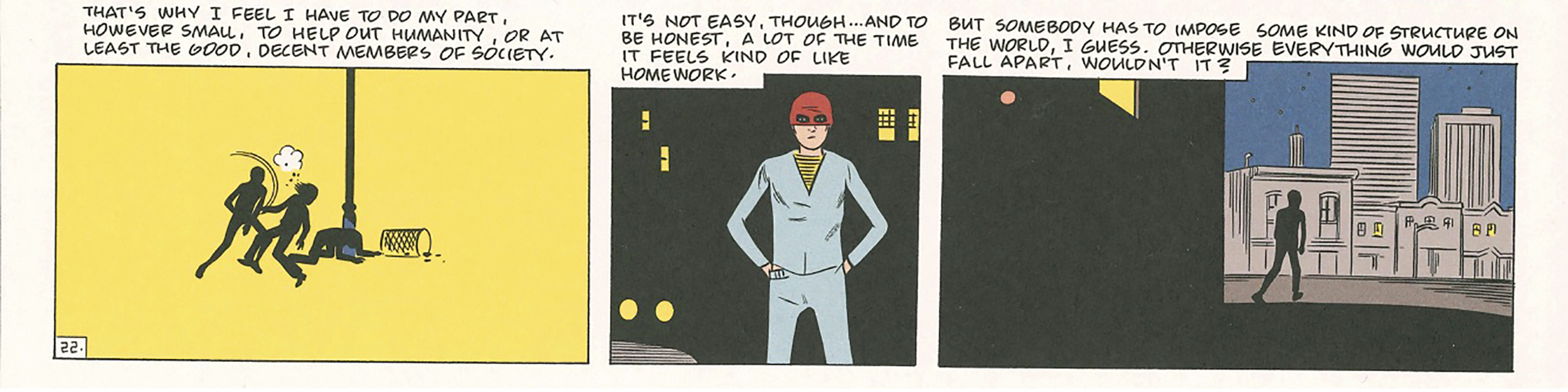
Sketch 7: Quadriptych

For my quadriptych comic, I started with the first panel being the opening image, then moved onto the next two panels being the conflict, and lastly, resolving the plot with the fourth panel. The construction of this plot felt a lot less restrictive than the triptych, as I had more space to communicate my story with more clear and detailed illustrations. Having the two middle panels to stretch my story allowed the storytelling to feel a lot less fast paced.

Sketch #6: What’s in your bag?

  1. My laptop bag (I LOVE STRAWBERRIES<3)
  2. My laptop (I cleaned it right before I took this picture ;))
  3. My pencil pouch with too many pens and pencils I do not even use (I am a stationery fiend)
  4. My chronically tangled earbuds
  5. My water bottle
  6. My pink iPad that is always at 15% 😦

After crafting this self-portrait by laying out the possessions of my backpack, I’ve realized that most of my belongings (no matter how mundane) perfectly capture my aesthetic. I feel like my friends could identify what belongs to me by simply looking at the color and pattern, so I think that this image is an accurate representation of who I am. The most challenging part about this assignment was trying to come up with clever captions that could also further encapsulate my identity. I think that representing oneself in a catalog of stuff in one’s bag is a form of writing, as it communicates a part of who we are in a creative way!

css.php