Literacy Narrative Part 2


ENGRD101.01. Fall 2023. Emory University
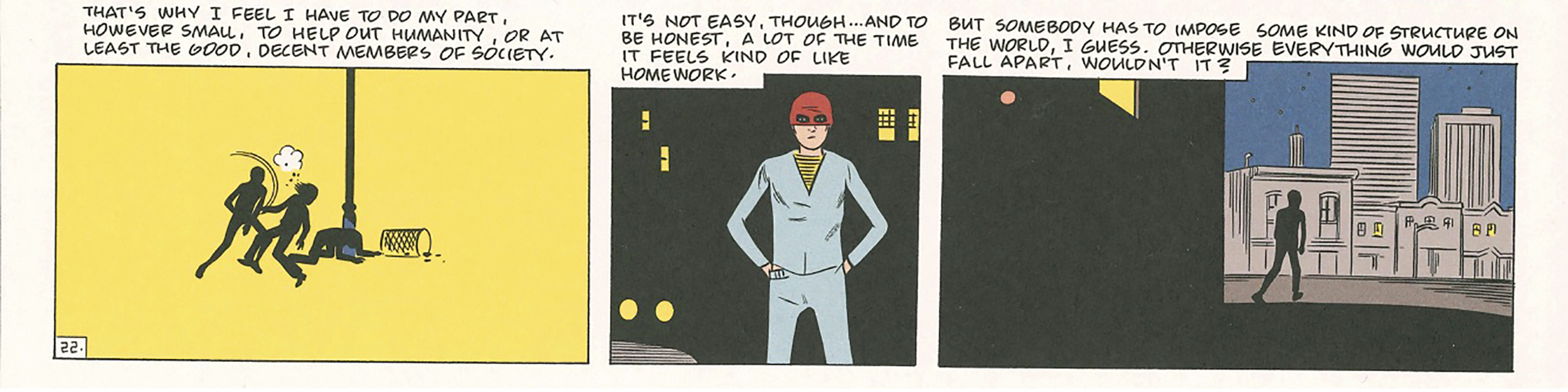
Both Stitches and Spinning use various techniques such as framing, omission, color, and angle to realistically re-visualize the authors’ emotions and traumatic memories. Such techniques used increase the reliability of the authors’ mood and promo the readers to make their own interpretations.
Stitches and Spinning use similar methods to portray and highlight emotionally intense moments. Both authors utilized the concept mentioned by Hillary Chute that “Cognitively, one’s eye usually first takes in the whole page, even when one decides to start in the upper left corner and move left to right (Chute).”—Both Tillie Walden and David Small reduce the size of the panels and fit a large number of them densely into one page. This change in panel organizations might induce the readers’ curiosity. Also, the compact configuration, combined with the content within the panels, might at the first glance give the audience a sense of quickened pace and intensified emotions. In addition, in both works, the time presented on the page seem to run slower than in other parts of the narrative: every movement and thought of the characters are captured in order to accentuate the tension of the moment. Moreover, on both pages the authors seem to isolate themselves and omit certain parts of the larger scene. Tillie Walden seems to focus only on herself during the scene at the competition, leaving out any information about the actual reactions from the audience and judges. The omission conveys how at the moment she was too panicked and embarrassed to look at the audience. David Small also excludes any mentions of his family’s reaction on the page. Knowing David’s mom’s earlier warning of not going near the elevators and her overall resentful personality, the readers are suspended wondering how she would react toward David’s behaviors.
Although there are many similarities on the two pages, the authors use different techniques to depict their mentality. For example, Tillie Walden seems to angle particular at herself throughout the page, showing her dread and possible wish of isolating herself at the moment. There was no change of angle, and Tillie Walden expresses her inner thoughts directly through words that occupy entire panels. On the other hand, David Small illustrates significant shifts in angle: first at himself, and then to the fetus leaping out of the jar.This shift illustrates how David Small tends to materialize his fears and imaginations and portray them visually as opposed to with words.

The two authors also use colors and framing differently. On the page, Tillie Walden creates two types of obviously distinct panels—one light and one dark. The light panels depict her movements and some of her thoughts, while the dark ones seem to represent her internal panic, which seems to grow exponentially after she falls. She also uses blank panels and repeated scenes of her sitting on the ground possibly to express how long that moment seemed to her in her shock and fear.

David Small doesn’t incorporate major shifts in colors or repetitions in his panels. However, there seems to be a change in the framing of the panels switching from reality to his imagination: the outlines of the first three panels have dark and well-defined edges. The outline disappears in the next two panels and reappears in the rest of the panels but becomes bolder, duller, and less defined. David Small uses outlines to separate his internal fantasies and external reality, while Tillie Walden uses uniform outlines throughout the page.
In order to utilize these technique and portray the moments realistically, the authors must revisit and investigate deep into details of their traumatic memories. For example, Tillie Walden must confront her sense of humiliation and panic again to create ideas such as using different color themes and repeated panels; likewise, David Small must remember his childhood monster in order to draw it out completely. Such endeavors help situate the readers in the authors’ point of view for them to better sympathize with the authors’ emotions at the particular moments. Increased relatability then allows readers to make their own more profound, metaphoric interpretations, such as how the fetus might represent the constant dread David Small faces with his own diseases and his controlling and somewhat selfish family, and how Tillie Walden’s reaction to herself falling reveals her fear toward the revelation of her identity. In Stitches and Spinning, Tillie. Walden and David Small use panel configurations, timing, and omission similarly, while they differ in their uses of angles, allots, and framing. The various techniques used by the two authors realistically illustrate their traumatic memories, helping the readers sympathize with the emotions and make their own further interpretations.
Work Cited
Chute, Hillary. “Comics for Grownups.” Introduction. Why Comics?, e-book ed.
Tracing Pages: https://docs.google.com/document/d/1GkcNVpZW0OdqanRzzcmakwqeMaCDEIEfPFlxAotnzGs/edit

This is based on my personal experience on fall break and almost all of school breaks, that four days of break seem to go by faster than one day of class. I think a challenge for me is to arrange the narrative into four panels and still accurately convey the message. I think adding one panel allows portrait of a process through time.
iPad—It’s mostly for taking notes in class.
A notebook—I almost never used it except for sometimes during creative writing class.
Some crumpled exams or handouts from class—I almost never remembered to organize them or put them in a binder or folder.
Two mechanical pencils and an eraser—I don’t know where my pencil case is.
A lipstick—sometimes after a long day of class, I would look pale as of O haven’t eaten anything in three days,
I think this portrait reflects my lack of organization (the lost pencil case and the messy papers) and also me caring about my own appearance. For the image, I decided to stack all of my stuffs together to recreate how messy they are in my school bag.

The inspiration comes from Al the question asked in the first panel by a friend. As I thought deeper about that question, I think humans are also more and less caged to the life and problems of our current job and role that we sometimes fail to see that there are larger possibilities.

Why is the desert white though?
The first thing that I related to this assignment was clouds, since their various and unpredictable shapes provide a vast space for imagination. As I searched up pictures of clouds on the internet, I came across this one in which the lower layer of the clouds seems almost to be a perfect plain. I thought that it would be adequate to add some animals there. During the process I had some trouble editing the size of the camels and cropping them out of the original picture.

I used my notes from my psychology lecture for this visual note taking assignment. Through the process I found out how “messy” my notes are and how many typos there are in my notes. I feel like this assignment helps me to categorize and memorize my notes. I feel like processing things visually is more effective for me to memorize the knowledge and the connections between them.

Is that a scotch tape in a fish tank?
My inspiration comes from a drowsy afternoon in my AP Literature class back in High School. The teacher was teaching something about the meaning of the symbolism of the white whale while my mind uncontrollably slipped away. I stared at the scotch tape dispenser on his table and thought, in that context, that it looked really like a whale.
The scotch tape that I bought looks not that much like a whale, but rather like a cartoonish-looking fish. I decided to make the hole in the middle as its eye and drew several smaller fish behind. I also think that the lego man figure on my keychain fits the ocean theme, so I added it in.
In my literary narrative, I discussed how books, classes, and the changes in language environment shifted my focus from reading and writing only for fun to emphasizing writing styles and techniques, and also the deeper meanings behind books and writing. As I thought about my favorite type of narrative for this essay, I realized that I might enjoy personal narratives more than fiction, which I used to prefer. Maybe it’s because of how personal narratives come more naturally from my real life experiences, the writing process feels more relaxing and inspiring, as if I was reliving a specific moment. In the process of thinking about my relationship with books, I found out that I still lack the interest in reading English books. Maybe it’s because of the tiresome process of having to search up words, or maybe it’s my shallow understanding in the language that makes me unable to fully appreciate the beauty of the language. However, I believe that more reading experiences will eventually strengthen my interest.


